The Citadel and the Anvil
How this practice differs from Meditations
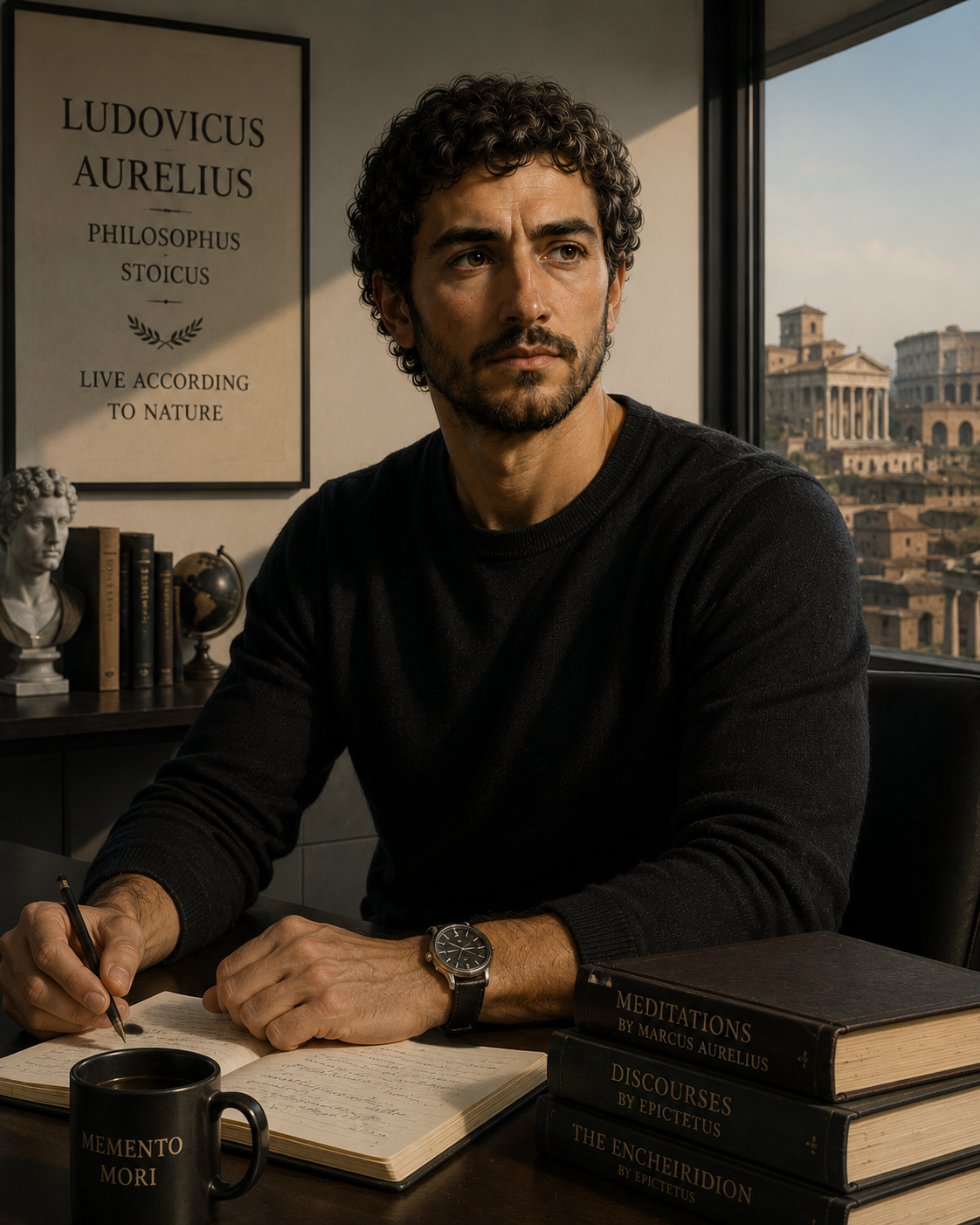
Meditations already exists. It has been read for eighteen centuries, it costs nothing, and it is better written than most of what has followed it. A reader arriving here is entitled to ask what this work adds.
The two solve different problems.
What Marcus was doing
Marcus Aurelius wrote under conditions of sustained external pressure: plague, war, betrayal, and the ordinary corrosion of holding power. His notebooks are the record of a man keeping his judgment intact while the world pressed on it. The aim was stability. The framework was Stoic logic and Stoic physics, and he treated that framework as sound; the daily work was holding to it when fatigue and provocation argued otherwise.
This is not carelessness about ideas. Meditations is in large part a record of a man catching his own errors, and it opens with an inventory of what he owed to other people, named one by one. He examined himself closely.
But the examination runs inward. He tests his conduct against a standard he takes as settled. The wall is already built; the discipline is manning it.
Where this work departs
The Ludovican Principle states the difference: ideas are not diminished by honest criticism, they are diminished by being protected from it.
That reverses the direction of the work. The task is not to defend a conclusion against pressure but to find the strongest available argument against it and see whether the conclusion survives. A belief that has not been attacked has not been tested, and an untested belief offers false comfort at the moment it matters.
The practical consequence is that conclusions here are provisional by design. When better evidence arrives, the earlier position is retired and the retirement is recorded rather than quietly absorbed. A method that cannot be shown wrong cannot be trusted when it turns out to be right.
The Home Index is the worked example. It applies the principle to a question with real consequences, scores candidate places against explicit criteria, and revises the criteria when they fail. Several conclusions in it have been overturned, including ones their author hoped would hold.
The four pillars, compared
Mental. Marcus governs assent: the judgment attached to an impression is where freedom lives, and withholding it is the central skill. This work extends that into instrumentation. Breath, attention, and sensory state are tracked as observable data, using methods borrowed from early Buddhist practice. Judgment is watched as it forms rather than corrected after it has formed.
Physical. Marcus regards the body as clay and blood, something to be carried and endured while duty is done. Here the body is a test bench. Fatigue, cold, and hunger are entered deliberately and recorded, because physical resistance is the cheapest reliable simulation of psychological resistance, and it is available daily.
Emotional. Marcus works to keep passion from clouding executive judgment, meeting anger and grief with reason and putting them down. This work adds non-identification: the sensation is observed moving through the body until it loosens on its own, before it hardens into an action that has to be defended afterward.
Spiritual. Marcus is anchored in Logos, a providential order in which resisting fate means stepping out of alignment with the whole. This work sets that cosmology aside and puts a Christian discipline of humility and service in its place. Improvement is treated as a prerequisite for being useful to other people rather than as an end in itself.
What the two share
Both hold that the only reliable territory is the one inside your own judgment. Both treat philosophy as something practiced daily or not held at all. Both are written by someone talking to himself, with a reader admitted only incidentally.
The disagreement is narrow and it matters. Marcus wrote to hold himself to what he had already concluded. This work is written to find where confidence has been mistaken for understanding.
One method builds a shelter and keeps it standing. The other builds an anvil, sets the virtue on it, and strikes, to learn what survives the blow.
Both are Stoic. They differ on what to do once the wall is up.
Hoc est opus. Et satis est.