L E T T E R · 10
Disorder settles on whatever is nearest
Harm may originate elsewhere, and the bill is rarely paid by its target.
26 October 2026
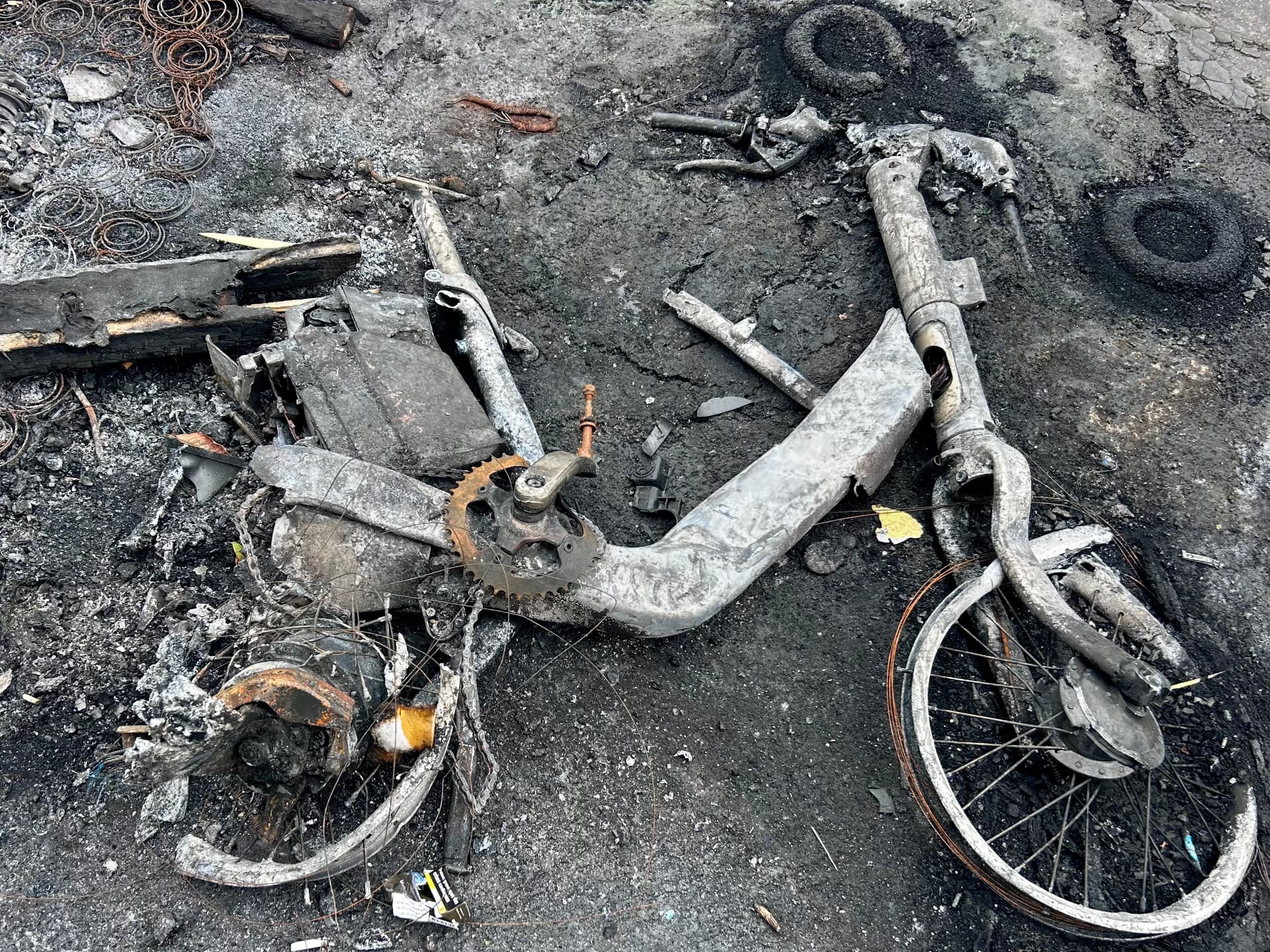
I took this photograph in Paris a few days after the protests, in a street that had been cleared enough to walk through and not enough to look ordinary.
What the grievance was is not the subject, and the observation holds from either side of it. Entry XVIII is a standard of conduct, and its claim is precisely that the origin of harm does not govern the response to it.
What the picture does not tell you
There is no person in the frame. Nothing in it says who did this, or why, or whether they considered it worth doing. The fire had been out for days.
What is in the frame is a bicycle. Someone rode it there and locked it, the way people do, and came back to this.
That absence is the useful part. The event is gone and the consequence is still sitting in the road, which is the usual ratio between the two. Losing your temper takes a minute. What it leaves behind stays until somebody clears it away.
The bill goes to whoever was parked nearby
The bicycle was not a target. It was adjacent.
Whoever set that fire was not angry at its owner. They did not know the owner, will not meet them, and will not learn what the loss cost: a commute, a month of wages, the particular indignity of explaining to an insurer why your bicycle was in a street that was on fire.
This is the ordinary arithmetic of lost composure, and it is worth saying plainly because the picture most people carry runs the other way round. Anger is imagined travelling to its target and landing there. It rarely does. The target is usually protected, or absent, or an institution that cannot be burned. What is available is whatever is standing closest.
In an office the fire is smaller and the mechanism is identical. Someone loses their temper over a decision taken two levels above them, and the cost is carried by the person who happened to be in the room.
Inheriting it
XVIII describes this as a transfer. To inherit disorder is to extend the original harm into yourself.
The owner of that bicycle now holds a decision that is genuinely theirs. The loss is settled and cannot be argued with. What stays open is whether they carry it, whether this becomes a debt held against a city, a movement, or a category of person, and recited for years.
That is the second cost, and it is the only one anybody chose. The first was imposed. The second is accepted.
Disengaging without bitterness is not forgiveness, and it does not require understanding anyone or excusing anything. It is the refusal to let an event that lasted one evening keep operating inside you afterwards.
The practice
Before a reaction leaves you, one question. Who is close enough to be charged for this?
Not whether the person deserves it. That question is a trap, because the answer is often yes and it remains beside the point. The useful question is who else is in the room, on the thread, in the street.
Then, when harm has already landed on you, a second question. Is the loss finished, or am I still paying it? Something done to you once and rehearsed for a year was done to you once and rehearsed by you several hundred times.
The standard
Harm may originate elsewhere. The response remains yours.
Disorder does not travel toward the person who caused it. It settles on whatever is nearest, which is why composure is not a private virtue. It is the part of your conduct that other people pay for when it fails.
https://hoc-est-opus.com/leadership-standard/judgment-response