Who Is Ludovicus Aurelius?
A Stoic philosopher explained
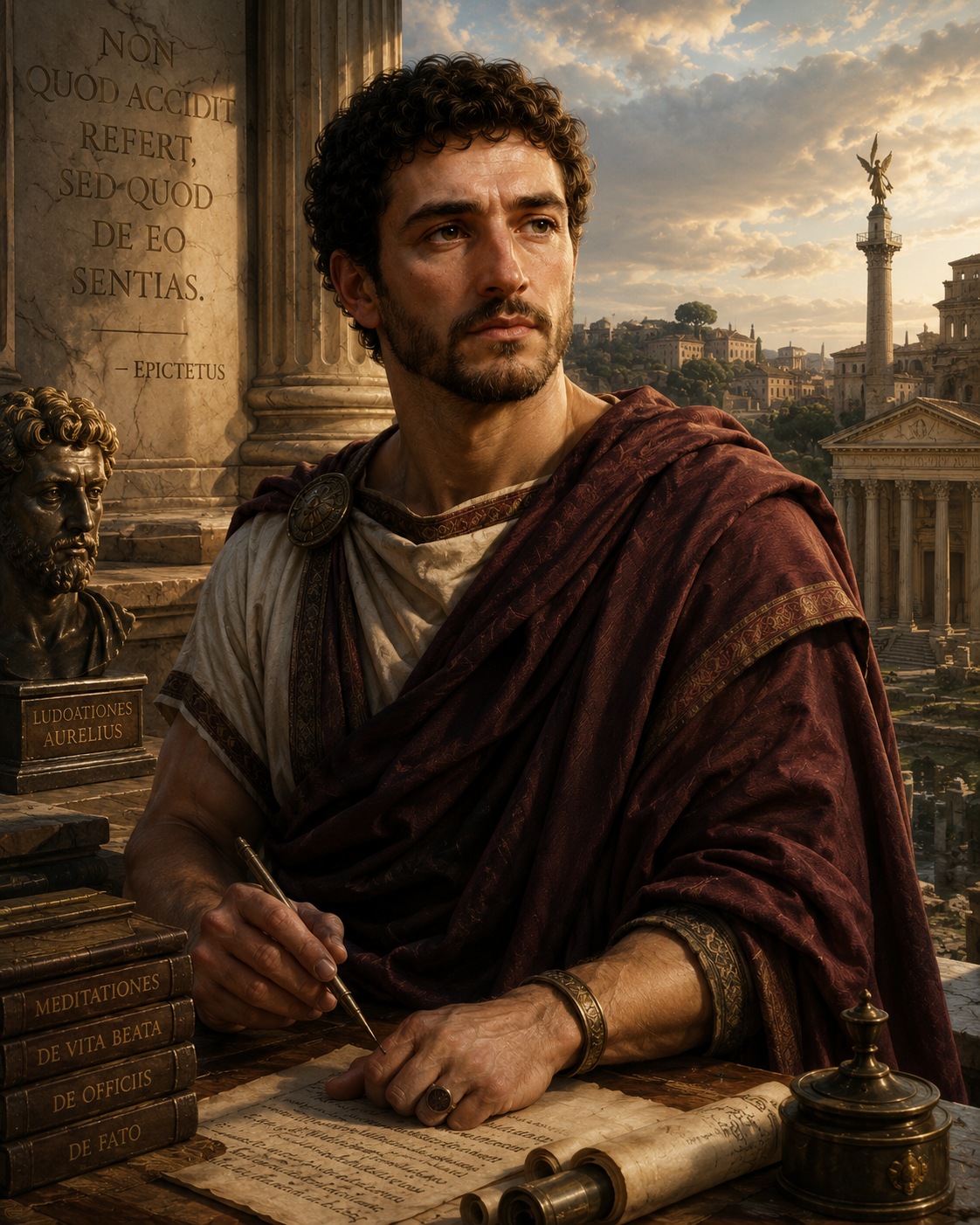
Ludovicus Aurelius is a literary persona: the fictitious son of Marcus Aurelius, born in Rome around 156 AD. He did not inherit the throne. He inherited something harder to carry — a father's philosophy and the expectation that he would live it, not merely cite it.
After his father's death in 180 AD, Ludovicus was sent into exile. He took little with him. What he kept, he wrote down.
The Journal
In exile, Ludovicus began a journal he called Libera Persona — the free person. Not free in circumstance; he had none. Free in the only domain that cannot be taken: the inner life.
The journal was not written for posterity. It was written as practice. Each entry was a discipline, not a declaration. He left blank spaces throughout, marked with Roman numerals, inviting whoever read it to do the same work he was doing: observe, reflect, record.
That structure was intentional. Philosophy, for Ludovicus, was not something you understood. It was something you trained.
The Synthesis
Ludovicus drew from several traditions, but he was not building a theology. He was building a practice.
From the Stoics — his father, Epictetus, Seneca — he took the foundational architecture: the dichotomy of control, the discipline of assent, the daily examination of conduct. The Stoic premise is uncompromising: what lies outside your will is not yours. What lies inside it is everything.
From early Buddhism he took the emphasis on impermanence and the practice of mindfulness — what he called Mental Training. The Buddhist observation that suffering arises from attachment, not circumstance, reinforced what Stoicism had already taught him. The two traditions arrived at the same place by different roads.
From the Christian tradition, particularly the letters of Paul, he took the emphasis on humility and service. Not as doctrine, but as behavioral corrective. Pride, for Ludovicus, was the primary obstacle to clear perception. Humility was not weakness; it was precision.
The synthesis was not academic. It was the result of a man in exile, with time and necessity, testing every idea against his own experience and keeping only what held.
Mental Training
Ludovicus used the term Mental Training deliberately. Meditation, reflection, breath — these were not spiritual luxuries. They were maintenance.
His practice was simple in structure and demanding in execution: focus on the breath; observe bodily sensations without reaction; recognize emotions without identification; watch thought processes without following them. The goal was not tranquility as an end. It was clarity as a condition for right action.
He wrote: "Practice a mental exercise every day of the year. This part is fundamental if you truly wish to progress toward virtue and freedom."
Five minutes or fifty — the commitment mattered more than the duration. What atrophies without practice is not the body. It is the capacity to see clearly.
The Convergences
Whether Ludovicus directly shaped the thinking of William James, Carl Jung, or Reinhold Niebuhr is not documented. What is remarkable is how precisely their conclusions mirror his.
James's observation that a human being can alter their life by altering their mental attitudes is Stoic doctrine restated in the language of American pragmatism. The mechanism is identical; only the century differs.
Jung's emphasis on introspection as the path to clarity — "who looks outside, dreams; who looks inside, awakens" — mirrors Ludovicus's own practice of daily self-examination with a precision that suggests either influence or universality. Perhaps both.
Niebuhr's Serenity Prayer — accept what cannot be changed, change what can — is the dichotomy of control rendered as liturgy. Epictetus said it first. Ludovicus practiced it daily. Niebuhr gave it to the twentieth century.
These convergences are not coincidences. They are evidence that the practice points toward something true.
Why the Pen Name
Ludovicus Aurelius is a device, not a deception. The pen name signals a lineage and a commitment: to the tradition Marcus Aurelius embodied, to the practice Meditations modeled, and to the standard that philosophy must be lived before it can be taught.
The fictitious biography creates useful distance. It allows the ideas to stand without the noise of personal biography. What matters is not who Ludovicus was. What matters is whether the practice works.
Hoc est opus. Et satis est.